
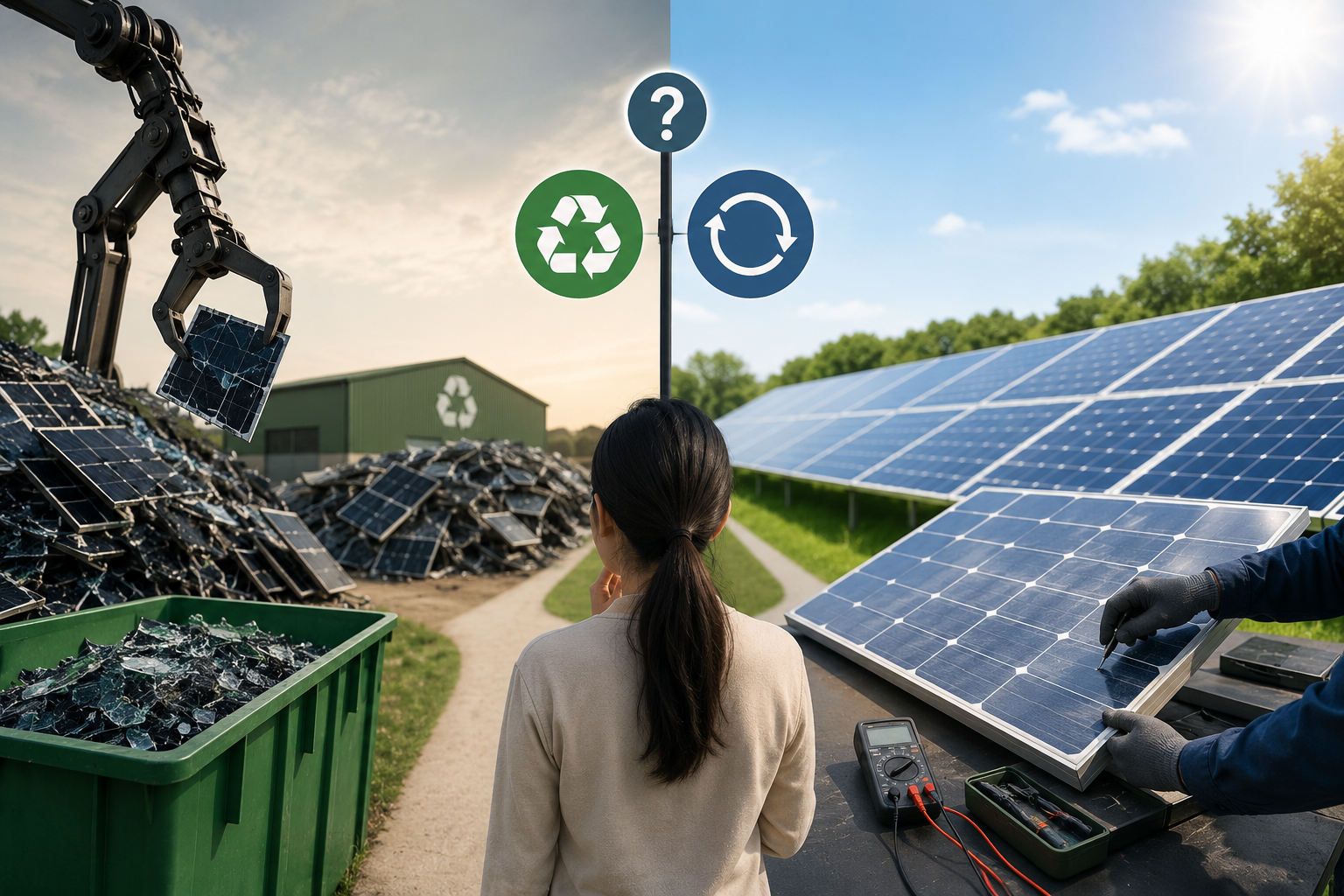
When people talk about sustainable solar, they talk about recycling. New requirements, new infrastructure, new headlines about what happens to a panel once it’s pulled off a roof. But recycling a panel means it has already failed. The more valuable question, the one almost nobody is asking, is what if it never had to?
Recycling and regeneration get used almost interchangeably in conversations about solar sustainability, as though they’re two versions of the same idea. They are not. They sit at opposite ends of a panel’s life, and confusing them leads to the wrong decision at exactly the moment it matters most: when a panel’s output starts slipping and an asset owner has to decide what to do about it.
What recycling actually is
Recycling is what happens at the true end of a panel’s life, the point where it can no longer usefully generate electricity and the only remaining value is in the materials it’s made of. A standard panel contains glass, aluminium framing, copper wiring, silicon, and small amounts of precious metals, all of which would otherwise sit in landfill for decades if left unprocessed. EtaVolt’s recycling technology, EtaPod, is built to recover that material properly: an automated, modular process that can reclaim moret than 96% of what’s inside a panel, rather than the partial, manual dismantling that limits most recycling operations today.
Recycling is, by definition, terminal. Once a panel goes through it, that asset is gone, there’s no scenario where a recycled panel goes back on a roof. It’s the right outcome when a panel is physically damaged beyond repair, when it’s reached the end of a multi-decade service life, or when the cost of doing anything else no longer makes sense. It’s also, increasingly, not optional, under Singapore’s Resource Sustainability Act, solar panels are regulated as e-waste, and asset owners carry real responsibility for how decommissioned panels are handled.
What regeneration actually is
Regeneration sits earlier in that timeline, while the panel is still installed and still producing power, just less of it than it should be. A large share of that lost performance comes from light-induced and light-and-temperature-induced degradation, LID and LeTID, mechanisms where boron-oxygen defects form inside the silicon and quietly trap the energy a cell is meant to convert into electricity.
For most of solar’s history, that loss was considered permanent. EtaVolt’s regeneration technology, EtaMax, treats it as reversible instead. By applying intense, controlled illumination and precisely managed temperature directly to an installed panel, on-site, in under five minutes, the process deactivates the defects responsible for LID and LeTID, recovering up to 5% of lost field performance and protecting the panel against further degradation of the same kind for up to five years.
The distinction that matters here is what regeneration is actually fixing. It addresses a specific category of electrical loss inside otherwise healthy silicon. It does not repair cracked glass, delaminated encapsulant, burnt junction boxes, or broken interconnects. It restores performance to a panel that’s structurally sound and not at the end of its usable life. It defers the moment recycling becomes necessary; it doesn’t replace recycling, it postpones it.
They are sequential, not alternatives
This is the part that’s easy to get backwards. Recycling and regeneration aren’t two competing solutions to the same problem, where you pick whichever sounds more convenient. They’re two stages of the same lifecycle, separated by a question of whether a panel still has productive life left in it.
A panel showing reduced output from LID or LeTID is a regeneration candidate, not a recycling candidate, because the asset is intact, the loss is electrical, and the loss is reversible. The same panel, years later, with cracked cells and a compromised frame, is a recycling candidate, because there’s nothing left for regeneration to act on. Regeneration is what you do to avoid an early, unnecessary trip to the recycler. Recycling is what eventually has to happen anyway, just hopefully much later, and to a panel that’s genuinely spent rather than one that was given up on too soon.
So how do you actually know which one applies?
In practice, the answer comes down to three questions, and none of them need to be guesswork if the panel is properly assessed first. Is the panel physically intact? Regeneration only works on healthy silicon inside an undamaged module. If there is cracked glass, delamination, a burnt junction box, or broken interconnects, regeneration has nothing to fix , the panel needs to be recycled regardless of how the underperformance started. Is the underperformance consistent with LID or LeTID? A gradual climate-driven decline in an otherwise intact panel, the pattern typical of P-type PERC modules in particular, points toward regeneration. A sudden drop, or damage traceable to a specific event like a storm or an installation defect, more often points toward physical failure that regeneration will not touch.
Does economics still work? Even on a healthy panel, regeneration only makes sense if the value of the recovered output and deferred replacement cost outweighs the cost of treatment. For most P-type panels still under, or just past their warranty window, that math tends to favour regeneration. For a panel already near the natural end of its rated life, recycling sooner rather than later may simply be the more sensible choice.
None of this needs to be a judgement call made from the roof. EtaVision, Etavolt’s inspection technology, exists precisely to answer these questions before any treatment happens, using I-V performance analysis and electroluminescence imaging to determine whether a given panel’s losses are recoverable or not. The assessment, not a guess, decides which path makes sense.
The takeaway
Recycling will always have its place, it’s the only responsible way to close the loop on a panel that has genuinely reached the end of its life. But treating recycling as the default answer to underperforming solar, rather than the last step in a longer process, leaves a lot of recoverable value on the table, and on the roof.
The more useful question isn’t recycling or regenerating. It is whether a panel has actually reached the point where recycling is the only option, or whether it’s still early enough that regeneration could buy it years more. That’s not something you can answer by looking at a generation report. It is something an assessment can answer in an afternoon.
Wondering which stage your panels are actually at? Talk to our team about a panel assessment.