
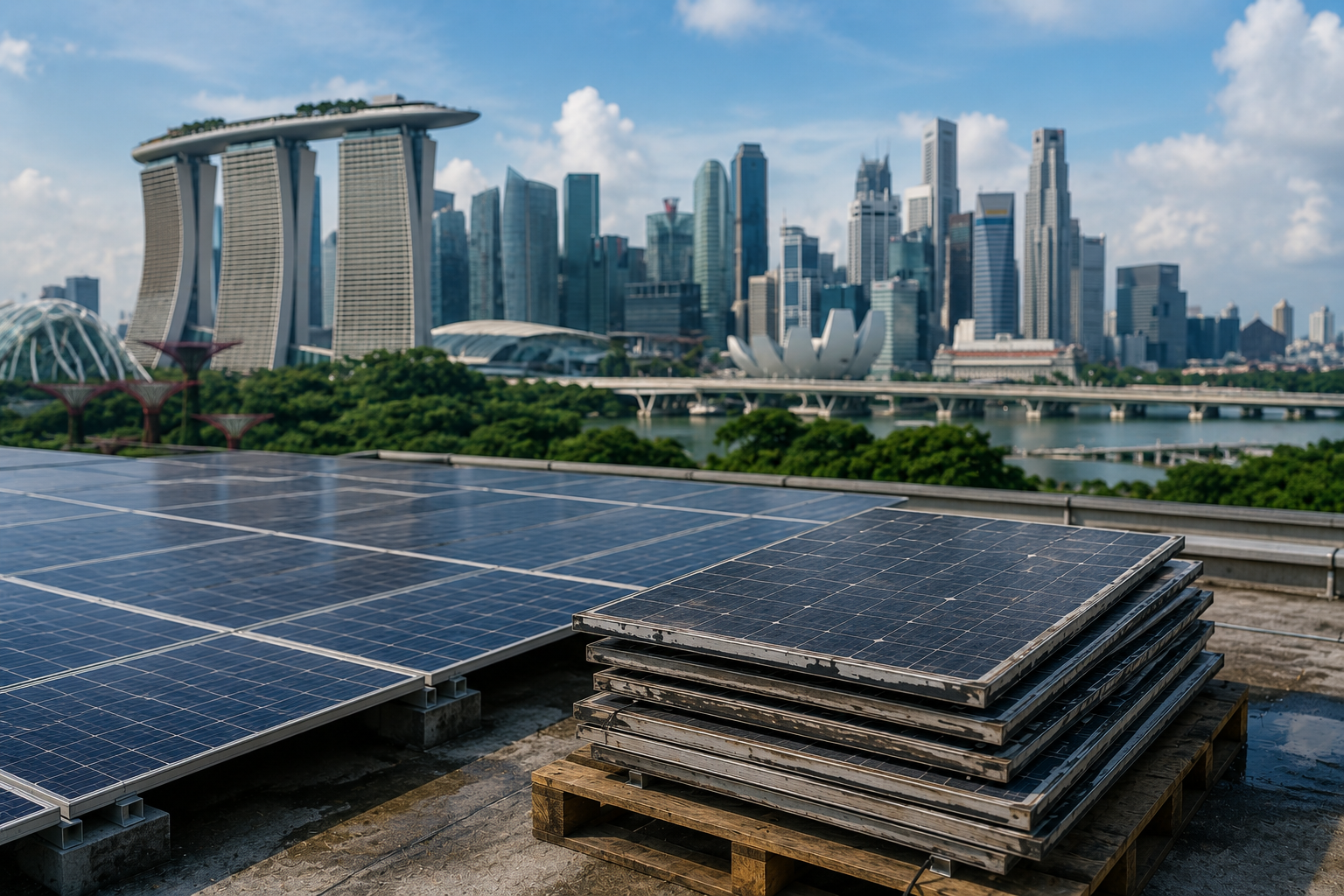
You installed solar panels to do the right thing. Lower emissions, lower electricity bills, and a visible commitment to sustainability. But when those panels eventually come down at end-of-life, whether due to ageing, damage, repowering, or system upgrades, do you know what Singapore law requires for solar panel disposal and recycling, and who is responsible for ensuring those panels are managed properly?
Most building owners and solar operators assume this is someone else’s problem—the installer’s, the recycler’s, or the government’s. That assumption is where the risk hides. Solar photovoltaic (PV) panels are one of only five product classes explicitly regulated as electronic waste under Singapore’s Resource Sustainability Act (RSA). That single fact reshapes how solar panel end-of-life management must be approached in Singapore, and it catches many organisations unprepared.
As more solar assets mature and solar repowering projects become increasingly common, understanding solar panel recycling and disposal requirements is no longer optional. This post explains what the RSA requires, where legal liability sits versus where the practical burden falls, and what proper solar panel end-of-life management looks like. More importantly, it helps answer a question every solar asset owner should be asking: are we compliant, or do we simply assume we are?
What the Resource Sustainability Act is
The Resource Sustainability Act 2019 is the legislative backbone of Singapore’s Zero Waste Masterplan, targeting waste streams with high generation volumes and low recycling rates. For e-waste, the Act operates on a principle known as Extended Producer Responsibility (EPR), which places responsibility for end-of-life management on companies that supply regulated products to the Singapore market.
The e-waste provisions came into force on 1 July 2021 and are administered by the National Environment Agency (NEA). Under these regulations, five product classes are covered: solar PV panels, ICT equipment, large household appliances, batteries, and certain lamps. Solar panels sit squarely within this framework. They are not exempt, nor are they a regulatory grey area.
This means that solar panel recycling in Singapore is governed by a formal legislative framework designed to ensure panels are properly collected, processed, and diverted from landfill when they eventually reach end-of-life.
The distinction that trips everyone up: Consumer vs non-consumer
Here is the nuance most summaries skip, and it matters enormously for solar panel end-of-life management.
The RSA separates regulated e-waste into consumer products and non-consumer products. Solar PV panels are treated as regulated non-consumer products because they are typically supplied to businesses, commercial building owners, industrial facilities, and solar operators rather than individual households.
This distinction changes how solar panel recycling works in practice. Consumer e-waste benefits from public collection points, retailer take-back schemes, and nationwide recycling infrastructure. None of these systems apply to commercial solar panels.
There is no public collection bin for a decommissioned rooftop solar array. Instead, responsibility for solar panel disposal and recycling is managed directly between producers and licensed e-waste recyclers. The chain of custody is therefore more visible, more traceable, and often subject to greater scrutiny.
If your understanding of e-waste recycling is based on dropping an old laptop or mobile phone into a collection point, set that model aside. Solar panel recycling in Singapore operates on an entirely different track.
Where legal liability actually sits
Under Singapore’s Extended Producer Responsibility framework, the formal legal obligation for solar panel end-of-life management sits with the producer of the solar panels.
The Ministry of Sustainability and the Environment has stated clearly that companies supplying solar PV panels to the Singapore market are responsible for their end-of-life treatment. In practice, producers must register with NEA, provide free take-back services for disused panels they supplied, and ensure those panels are sent to licensed e-waste recyclers for proper processing.
The RSA defines a producer as a business that supplies regulated products in Singapore and, in furtherance of that business, imports or manufactures those products. This means solar EPC contractors, distributors, importers, and manufacturers may all fall within the scope of these obligations.
Failure to comply is not a trivial matter. The Act grants enforcement powers to authorised officers, including the ability to inspect non-residential premises and investigate potential contraventions. Non-compliance can result in significant penalties.
At first glance, this may appear to be solely a producer issue. In reality, the situation is more complicated.
Why asset owners are exposed even when they are not the producer
Legal liability and practical responsibility are not always the same thing. While the statutory obligation may sit with the producer, the operational burden often falls on the building owner or solar asset owner when panels are removed.
The first challenge is that solar installations often outlive the companies that supplied them. A contractor that installed a rooftop system fifteen years ago may have merged, closed, or exited the market entirely by the time the panels reach end-of-life. The panels remain on your roof, and the need for compliant solar panel disposal does not disappear simply because the original supplier no longer exists.
A second challenge arises when ownership changes hands. Many organisations acquire buildings with existing solar installations but have little documentation regarding the original supplier, warranty arrangements, or take-back obligations.
Repowering projects present another growing issue. As newer, more efficient solar technologies become available, many asset owners are replacing older modules before they have completely failed. These solar panel decommissioning projects can generate hundreds or even thousands of panels requiring assessment, reuse, regeneration, or recycling. Disposal planning therefore needs to be incorporated into project design from the outset rather than treated as an afterthought.
There is also the growing importance of documentation. Increasingly, organisations must be able to demonstrate responsible end-of-life management, not simply claim it. Sustainability reporting, ESG disclosures, and stakeholder expectations are placing greater emphasis on traceability and proper recycling practices. If you cannot show where your decommissioned panels went, you may face reputational and compliance risks regardless of where the legal obligation technically sits.
In short, the law names the producer, but the practical responsibility often lands on whoever owns the panels when they come down.
What solar panel end-of-life management actually looks like
Many people think solar panel recycling is a single step. In reality, effective solar panel end-of-life management follows a hierarchy, and recycling should be the last option rather than the first.
The first step is determining whether removal is actually necessary. As the Singapore Green Building Council has noted, organisations should avoid creating unnecessary waste in the name of sustainability. Replacing functioning panels prematurely destroys value and creates avoidable waste streams. Before any panel is removed, its condition should be assessed through inspection and performance analysis to determine whether it has genuinely reached end-of-life.
The second step is reassessment and grading. Panels removed during upgrades are not automatically waste. By evaluating remaining performance capacity through techniques such as I-V curve analysis and electroluminescence inspection, panels can be categorised according to their remaining useful life. Some may be suitable for reuse, others for regeneration, while only the poorest-performing units proceed directly to recycling.
The third step is regeneration. Certain forms of degradation, particularly light-induced and heat-induced degradation common in tropical environments, may be partially reversible. Regeneration technologies can restore lost performance and extend the productive life of solar assets, reducing both replacement costs and future waste generation.
Only after these options have been exhausted should panels proceed to recycling. For panels that have genuinely reached end-of-life, Singapore’s regulations require that they be processed through licensed e-waste recyclers rather than general waste contractors. Proper solar PV recycling enables valuable materials such as glass, aluminium, copper, and silicon to be recovered and returned to the supply chain, supporting Singapore’s broader circular economy objectives.
Compliance is not a cost, It is a value recovery opportunity.
It is easy to view solar panel recycling and end-of-life compliance as a burden. A more useful perspective is to see it as an opportunity.
The same practices that support compliance—assessing panels before removal, regenerating viable assets, and recycling only when necessary—also help preserve the value of solar investments. Panels that remain productive generate returns for longer. Materials recovered through recycling retain economic value. Documentation supporting responsible end-of-life management strengthens sustainability reporting and demonstrates environmental stewardship.
That is ultimately the foundation of a circular solar economy: ensuring that clean energy infrastructure does not become tomorrow’s waste problem.
As more solar assets across Singapore approach maturity, building owners and solar operators will need to think beyond installation and generation. Solar panel end-of-life management, solar panel recycling, and solar asset lifecycle planning are becoming critical parts of responsible asset ownership.
Not sure where your solar assets stand? Etavolt works across the full solar lifecycle, from reassessment and regeneration to compliant solar panel recycling in Singapore. Whether you are planning a solar repowering project, evaluating ageing assets, or developing an end-of-life strategy, our team can help you identify which panels still have value, which can be regenerated, and which should be recycled through licensed channels.