As the global installed base of solar PV systems continues to grow, so too does the number of solar panels entering the recycling and recovery stream. While many modules have genuinely reached the end of their service life, others are removed for reasons such as system upgrades, site redevelopment, insurance claims or equipment replacement.
For recycling facilities, distinguishing between a panel that is suitable for material recovery and one that may still have functional value is becoming increasingly important. Relying solely on visual inspection can make this assessment challenging, particularly as external appearance does not always reflect a module’s electrical performance.
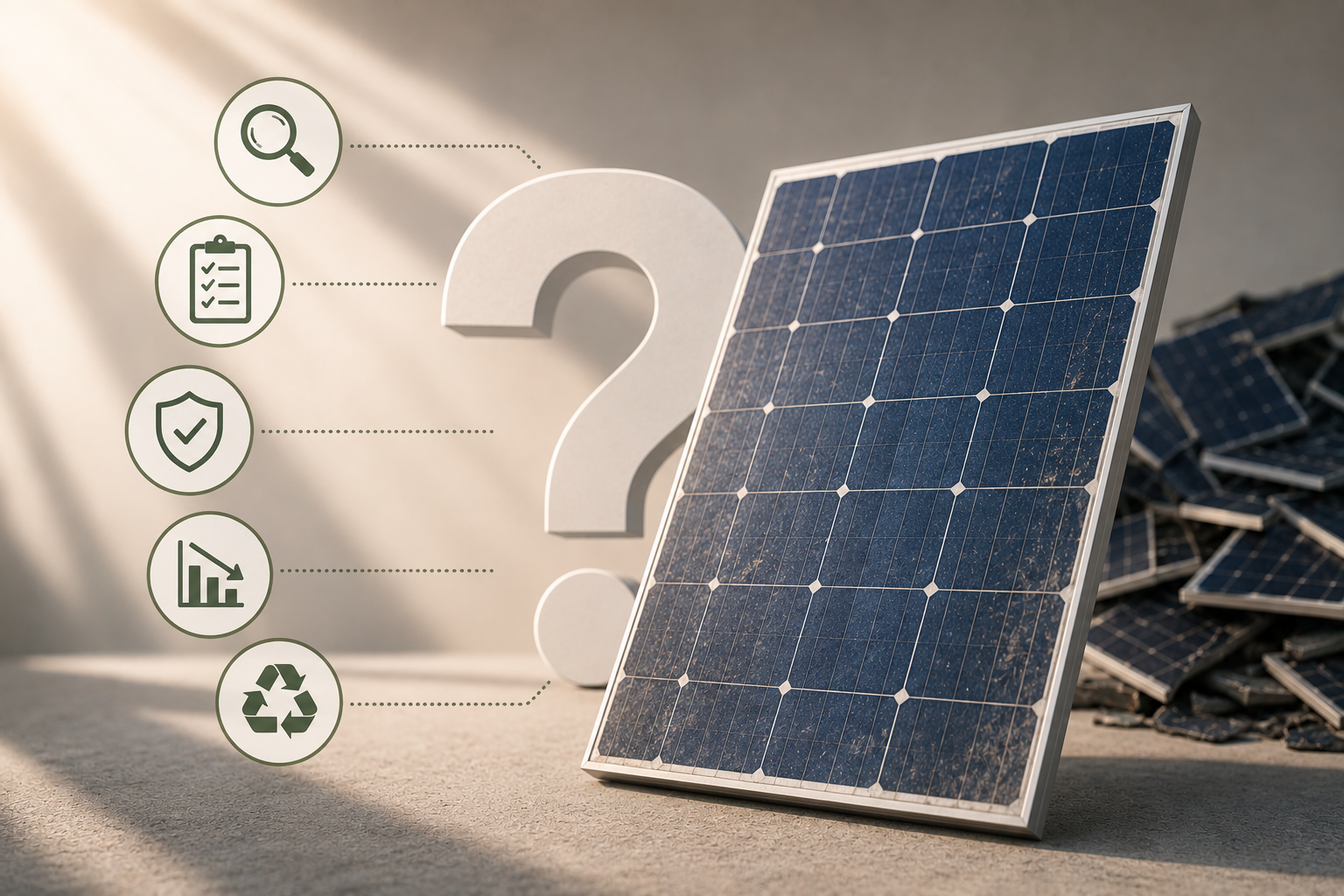
Before routing a solar panel for recycling, here are five questions worth considering.
1. Has the Solar Panel Reached End-of-Life, or Is It Simply Underperforming?
A solar panel’s appearance alone does not necessarily indicate its remaining performance.
Visible damage such as frame corrosion, cracked glass or discolouration may suggest deterioration, but these characteristics do not always determine whether a module can still generate electricity effectively. Conversely, a panel that appears to be in good condition may have internal defects that are not visible during a standard visual inspection.
Determining whether a module has truly reached the end of its usable life typically requires objective testing rather than visual assessment alone.
2. Is the Panel’s Remaining Capacity Being Measured or Estimated?
Panel age is often used as a quick reference point, but it is only one factor influencing long-term performance.
Actual output can vary depending on module technology, environmental conditions, operating temperatures, installation quality and maintenance history. Two panels of the same age may perform very differently after years of operation.
Objective electrical testing provides a more reliable basis for grading than assumptions based solely on age or appearance.
3. Could the Panel Be Suitable for Reuse Before Recycling?
Recycling enables valuable materials such as aluminium, glass, copper and silicon to be recovered for future use. However, where appropriate and subject to safety, performance and regulatory requirements, some panels may also be suitable for refurbishment, secondary applications or resale.
Identifying these opportunities typically requires a structured assessment process that evaluates both electrical performance and physical condition.
Accurate grading helps ensure each panel is directed towards the most appropriate recovery pathway.
4. Are Grading Decisions Consistent Across Every Inspection?
Visual inspections remain an important part of the recycling process, but manual assessments can naturally vary between operators, shifts and working conditions.
Establishing consistent grading criteria supported by objective data can help improve repeatability, reduce uncertainty and support more standardised decision-making across facilities.
As processing volumes increase, consistency becomes increasingly important for operational efficiency and quality assurance.
5. Can the Grading Decision Be Documented?
As the solar recycling industry continues to mature, many organisations are placing greater emphasis on traceability, documentation and transparent decision-making.
Maintaining records of inspection results, testing outcomes and grading decisions can support internal quality processes while providing greater confidence for downstream buyers, refurbishment partners and other stakeholders.
Documented assessments may also assist facilities in demonstrating consistent processes where required.
Where EtaVision Fits
EtaVision is designed to support solar panel inspection by providing data-driven assessments that complement traditional visual inspection.
Rather than relying solely on external appearance, the system evaluates panel condition using objective inspection data to support consistent grading decisions. Inspection results are digitally recorded, providing a documented assessment that can assist facilities in determining whether a panel is more suitable for reuse, refurbishment or material recycling.
By introducing greater consistency into the inspection process, recycling facilities can make more informed routing decisions while maintaining a clear record of each assessment.
The Future of Solar Panel Recycling
The volume of end-of-life solar panels is expected to increase over the coming decades as earlier generations of PV installations reach the end of their operational lives.
As recycling capacity expands, efficient inspection and grading processes will play an increasingly important role in supporting material recovery, reuse opportunities and responsible resource management.
Facilities that combine experienced personnel with objective inspection technologies are likely to be better positioned to make consistent, data-informed decisions as processing volumes continue to grow.
If you would like to learn more about how EtaVision supports solar panel inspection and grading, our team would be happy to discuss your current workflow and explore where data-driven assessments may add value.