
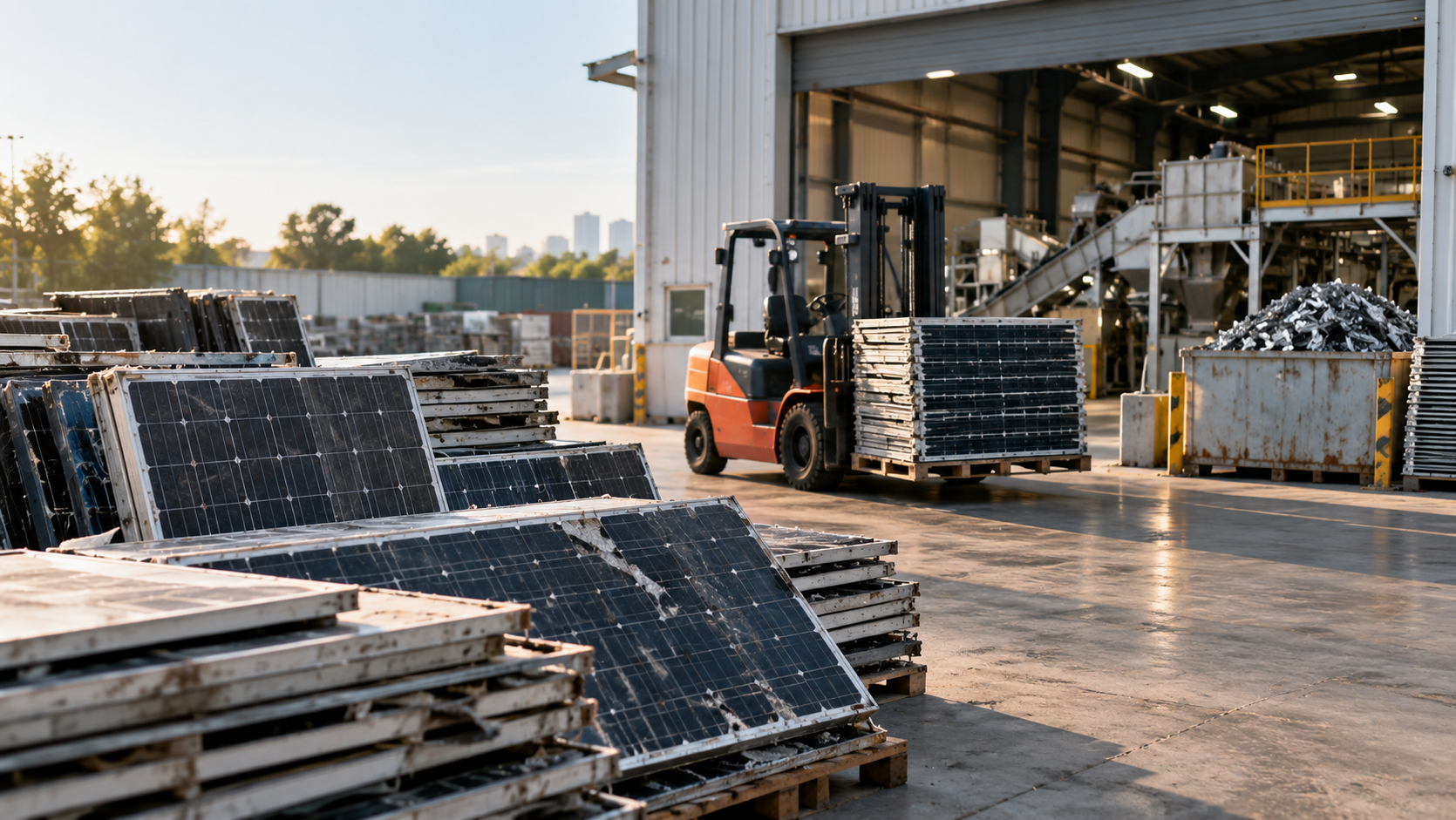
The solar industry has spent the last two decades scaling at remarkable speed, creating an enormous installed base of photovoltaic panels across rooftops, commercial facilities and utility-scale solar farms. But as this first generation of solar assets begins to age, another opportunity is emerging alongside the growth of renewable energy: the recovery and processing of end-of-life solar panels.
For e-waste recyclers, this represents more than another category of waste. Solar panels contain valuable materials including glass, aluminium, silicon, copper and silver, while their large size and relatively standardised construction make them a potentially significant feedstock for specialised recycling operations. The challenge is that processing PV modules at scale requires more than simply adding another material to an existing recycling line. Recyclers need to understand what is coming in, determine the condition of each module and build efficient pathways for recovering as much value as possible.
This is where solar panel inspection and recycling technology can play an increasingly important role.
The challenge begins before the recycling process
One of the biggest opportunities for recyclers is also one of the simplest: knowing what they are receiving.
Decommissioned solar panels do not all arrive in the same condition. Some have experienced years of degradation, some have physical damage, while others may have been removed as part of a system upgrade even though they remain functional. Two modules that look similar externally can have very different electrical performance and cell-level conditions.
For recyclers handling large volumes, relying primarily on manual visual inspection can make it difficult to classify incoming modules consistently and efficiently. A more comprehensive assessment requires both electrical and physical information, particularly when recyclers need to determine how different panels should be handled further down the processing chain.
This is where automated inspection becomes valuable. By combining IV testing and electroluminescence (EL) imaging, an inspection system can provide a more complete view of module performance and cell condition than visual inspection alone. Automated identification and data capture can then connect individual modules to their test results, creating a more structured information layer before they move into subsequent processing.
For an e-waste recycler, this can change the role of inspection from a basic quality check into an important part of the operation itself. Better information can support more consistent sorting, improve process planning and give recyclers greater visibility over the material entering their facility.
Turning inspection data into operational value
At industrial scale, efficiency is not only about how quickly a recycler can process a panel. It is also about how quickly the recycler can make the right decision about that panel.
An automated In-Factory Inspection System can integrate IV and EL testing into a conveyor-based workflow, allowing modules to be assessed systematically as they move through the line. With features such as barcode-triggered testing, centralised data management and automated reporting, inspection results can be associated with individual modules or batches rather than remaining as disconnected test records.
For recyclers, this creates several potential advantages. Incoming modules can be assessed more consistently, data can be captured without relying entirely on manual processes, and inspection results can provide a clearer basis for deciding how panels should proceed through the operation. Over time, the data generated from these inspections can also help operators understand recurring defect patterns, incoming material quality and processing performance.
The value, therefore, is not simply in testing a panel. It is in creating a more intelligent and traceable recycling pipeline.
Recycling is becoming a bigger materials opportunity
Once a solar panel has genuinely reached the end of its useful life, the next challenge is recovering value from the materials it contains. A typical photovoltaic module consists of multiple layers and materials, including glass, aluminium, silicon, copper, polymers and small quantities of other valuable metals. Separating these materials efficiently is technically more challenging than simply removing the aluminium frame or processing the glass.
As the volume of PV waste increases, this creates an opportunity for e-waste recyclers with the technology and infrastructure to process photovoltaic modules more effectively. The ability to recover a greater proportion of useful materials can improve the economics of each panel entering the recycling stream while supporting the broader transition towards a circular solar industry.
However, recycling economics are also closely connected to logistics. Solar panels are bulky and are distributed across thousands of installations, meaning transportation can become a significant cost when panels need to travel long distances before processing begins.
Why decentralised recycling could matter
This is one reason decentralised recycling is gaining attention within the solar waste ecosystem. Rather than concentrating all processing in a small number of large facilities, modular recycling systems can potentially bring processing capability closer to where panels are collected and decommissioned.
EtaVolt’s EtaPod is designed around this concept as a compact, modular and self-contained solar panel recycling solution. By enabling recycling capacity to be deployed closer to the source of PV waste, the approach can help reduce unnecessary transportation while giving operators greater flexibility as regional volumes grow.
For e-waste recyclers, this could create opportunities to expand into PV recycling without relying entirely on a traditional centralised model. A modular approach can also make it easier to consider different deployment models depending on local panel volumes, collection networks and customer requirements.
More importantly, decentralised processing does not have to mean less visibility. Tracking and reporting can be integrated into the recycling workflow, giving operators greater visibility into what is processed and what materials are recovered. As customers and regulators increasingly look for evidence of responsible waste handling, traceability can become an important part of the value proposition.
Building the next generation of PV recycling
The opportunity for e-waste recyclers is therefore not simply to process more solar panels. It is to build a more efficient and data-driven PV recycling pipeline, from the moment a module enters the facility to the moment its materials are recovered.
Inspection provides the information needed to understand incoming modules. Automated testing can make that assessment more consistent at scale. Recycling technology then provides the pathway for recovering materials, while decentralised processing can help address the logistical challenges created by the geographic distribution of solar assets.
Together, these technologies can help transform PV waste from a growing waste-management challenge into a more structured source of recoverable materials.
For an industry already experienced in handling complex waste streams, solar panels represent a new opportunity to apply that expertise to one of the fastest-growing renewable energy technologies in the world. The recyclers that begin building the capabilities to inspect, classify and process PV modules today will be better positioned as the volume of end-of-life solar panels continues to grow.
The future of solar is not only about generating more clean energy. It is also about creating the infrastructure to recover value from the technology once it leaves the field.
Want to know what your solar assets are actually worth at end-of-life and how much of that value can be recovered before disposal is even the right call? Get in touch with us to learn more about in-factory inspection system and decentralised recycling for your PV fleet.