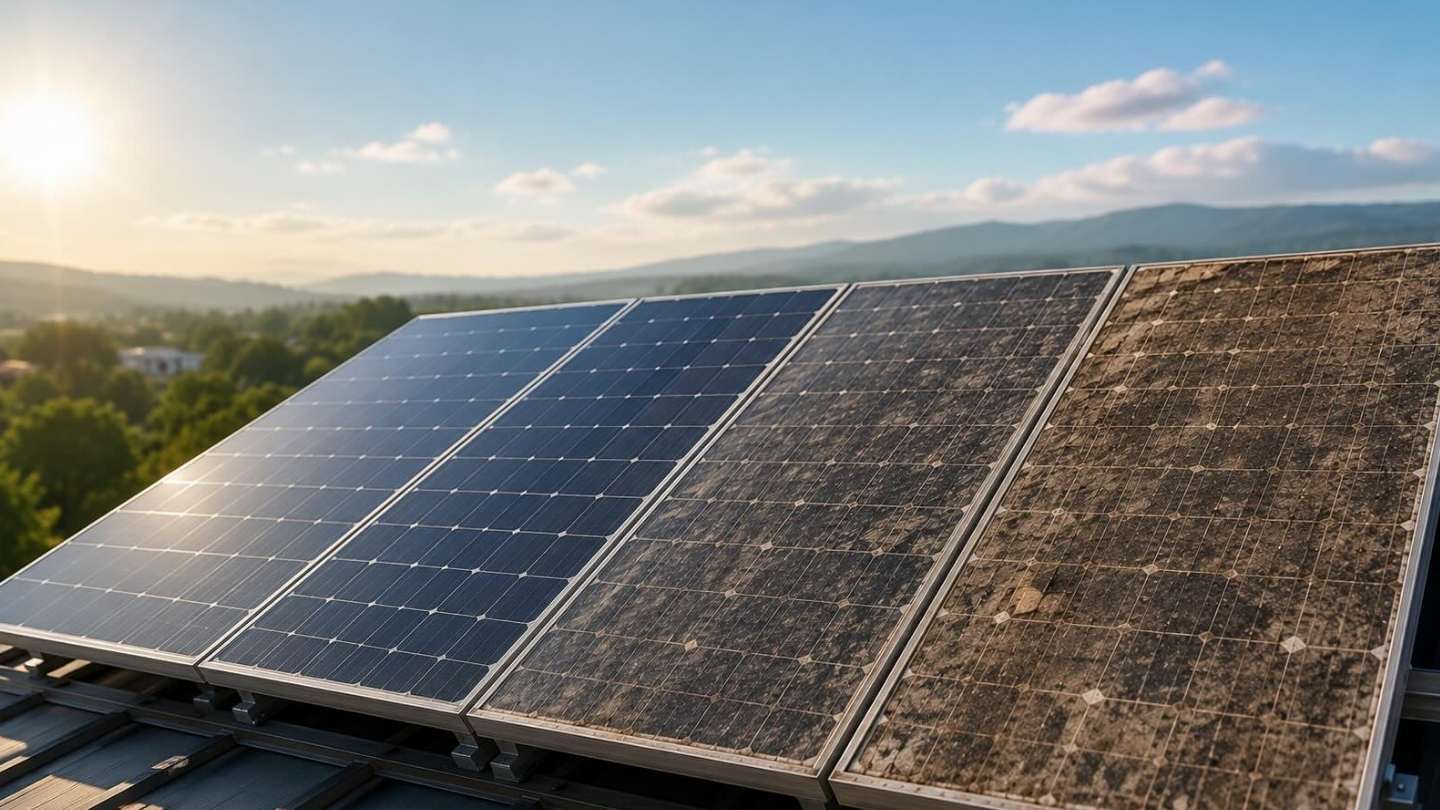
Solar panels can lose up to 10% of their performance over their lifespan. In Singapore’s heat, humidity, and near-constant sunlight, that degradation often begins earlier and compounds faster than many asset owners realise.
Most operators accept solar panel degradation as inevitable. To some extent, it is. But the assumption that declining solar output can only be solved through panel replacement is increasingly being challenged.
The solar industry has long relied on a comfortable promise: install a solar panel today, and it should continue generating electricity for 25 to 30 years while losing only a small fraction of its output each year. That expectation underpins financial models, return-on-investment calculations, and long-term solar asset management strategies around the world.
However, there is an important caveat. Much of the data behind those lifespan assumptions was developed in temperate regions such as Germany, Northern Europe, and parts of the United States. These are climates where panels experience cooler operating temperatures, lower humidity, and seasonal variations that naturally reduce environmental stress.
Singapore is not one of those climates.
Panels installed here operate in one of the most demanding environments for photovoltaic systems. The same conditions that make solar energy attractive—high irradiance, abundant sunshine, and year-round generation potential—also accelerate the degradation mechanisms that slowly erode performance from within.
For solar asset owners, commercial building operators, and utility-scale developers, understanding why solar panel performance loss occurs is becoming increasingly important. More importantly, understanding what can be done about it could significantly improve long-term asset value and delay costly replacement decisions.
The 25-year promise was written for a different climate
A typical solar panel warranty guarantees that a module will still produce around 80% to 85% of its original output after 25 years. Most manufacturers assume an initial performance drop of approximately 2% to 3% in the first year, followed by an annual degradation rate of around 0.5%.
These figures are not misleading. They simply reflect average conditions.
Move the same panel into a tropical environment, and the mathematics begins to change.
Field studies have consistently shown that solar panel degradation in tropical climates can exceed the assumptions commonly used in warranty models. Higher operating temperatures, elevated humidity levels, and increased solar irradiance create additional stress on photovoltaic cells, often increasing annual degradation rates beyond temperate-climate benchmarks.
At first glance, an additional 0.2% or 0.3% decline per year may not sound significant. Over two decades, however, the effect compounds. A solar asset expected to deliver reliable performance for 25 years may reach underperformance thresholds years earlier than anticipated, reducing energy generation and impacting project economics long before replacement was ever expected to enter the conversation.
To understand why this happens, it helps to look beyond the visible components of a solar panel and examine what is happening inside the silicon itself.
What causes solar panel performance loss over time?
When people think about ageing solar panels, they often picture dirt accumulation, corrosion, cracked glass, or weather exposure. While these factors can affect performance, some of the most important causes of solar panel efficiency loss are invisible to the naked eye.
The real story takes place at the microscopic level inside the silicon cells, where prolonged exposure to light, heat, and electrical stress gradually alters the material’s ability to convert sunlight into electricity.
Three degradation mechanisms are particularly important for understanding solar panel performance loss in Singapore: Light-Induced Degradation (LID), Light and Elevated Temperature-Induced Degradation (LeTID), and Potential-Induced Degradation (PID).
Light-Induced Degradation (LID)
LID is often the first performance loss a solar panel experiences.
Within the first few hundred hours of sunlight exposure, many crystalline silicon modules lose between 2% and 3% of their rated output. This occurs because traces of oxygen remaining from the manufacturing process interact with boron dopants within the silicon, forming what researchers call boron-oxygen complexes.
These microscopic defects act like tiny traps within the cell. Instead of allowing charge carriers to flow freely and generate electricity, they capture some of the energy before it can be converted into usable power.
A useful analogy is a bucket with small holes punched into the bottom. Water continues flowing into the bucket, but some of it escapes before it can be used. The same principle applies inside the solar cell. The sunlight is still arriving, but a portion of its energy is effectively leaking away.
Light and Elevated Temperature-Induced Degradation (LeTID)
If LID is the first hit, LeTID is often the more significant long-term challenge.
Unlike LID, which generally stabilises after the initial performance drop, LeTID develops gradually over months or even years. It occurs when solar panels are simultaneously exposed to strong illumination and elevated operating temperatures.
This is where Singapore becomes particularly relevant.
Many commercial rooftop systems in Singapore routinely experience panel temperatures above 60°C. In cooler climates, modules may only reach these temperatures occasionally during summer peaks. In Singapore, they can operate under such conditions for extended periods almost every day of the year.
As a result, the degradation clock effectively runs faster.
LeTID has been widely observed in P-type PERC modules, which make up a substantial portion of the global installed solar fleet. For asset owners operating ageing PERC installations, this degradation mechanism can quietly contribute to declining solar output long before obvious signs of underperformance appear.
Potential-Induced Degradation (PID)
The third major degradation mechanism is PID.
PID occurs when high system voltages interact with moisture and electrical stress, causing ions to migrate within the panel structure. This creates unwanted leakage pathways that reduce the module’s ability to generate electricity efficiently.
Unlike some forms of degradation that progress slowly, severe PID can lead to significant performance losses if left unaddressed.
Unfortunately, the conditions that encourage PID are also common in tropical environments. High humidity levels, elevated temperatures, and prolonged exposure to moisture create an environment where the risk of PID becomes considerably higher than in drier climates.
Notice the common thread running through all three degradation mechanisms: light, heat, and humidity.
Singapore provides all three in abundance.
Why Singapore may be one of the most challenging environments for solar assets
Singapore’s strength as a solar market is also its challenge.
The country receives strong solar irradiance throughout the year, allowing systems to generate electricity consistently without the seasonal fluctuations experienced elsewhere. However, that same sunlight increases the carrier injection effects associated with both LID and LeTID.
At the same time, rooftop installations frequently operate at temperatures well above the thresholds known to accelerate degradation.
Humidity adds another layer of stress. Persistent moisture can contribute to PID while also accelerating the ageing of encapsulants and other protective materials designed to shield solar cells from environmental exposure.
Each factor would present a challenge on its own.
Combined, they create a near-perfect environment for solar panel degradation.
The result is often a widening gap between the performance asset owners expected when the system was installed and the energy generation the system actually delivers years later.
The hidden financial impact of declining solar output
One of the most challenging aspects of solar panel degradation is that it rarely announces itself dramatically. Most systems continue operating. Electricity is still generated. Dashboards continue reporting production.
Yet beneath the surface, performance may be quietly declining.
A seemingly small reduction in output can have meaningful consequences when multiplied across hundreds or thousands of panels. Lower energy generation reduces project returns, affects payback periods, impacts sustainability targets, and ultimately diminishes overall asset value.
For operators managing large rooftop portfolios or utility-scale projects, even a few percentage points of lost performance can translate into substantial long-term revenue losses.
This is why solar panel health assessment is becoming an increasingly important part of modern solar asset management. Understanding actual field degradation is often the first step towards improving asset performance and recovering lost value.
The industry’s historical problem: there was no fix
For most of the solar industry’s history, degradation was viewed as a one-way process.
Once defects formed within the silicon structure, those losses were generally considered permanent. Asset owners had two options: tolerate the decline in performance or replace the affected panels entirely.
Neither option was particularly attractive.
One gradually eroded returns over time. The other required significant capital expenditure to replace modules that often remained structurally sound despite experiencing electrical performance loss.
The underlying assumption was simple: degradation happens, and there is little that can be done about it.
That assumption is beginning to change.
Regeneration: repairing the cell instead of replacing the panel
One of the most interesting developments in solar asset life extension is the growing understanding that some degradation mechanisms can be reversed.
The same physics that causes certain defects to form can, under carefully controlled conditions, be used to deactivate or repair them.
Research conducted by leading institutions has demonstrated that the boron-oxygen defects responsible for LID can be permanently deactivated through regeneration processes involving controlled temperature and illumination. Studies have also shown that cell performance can improve significantly following regeneration treatment.
This scientific foundation underpins Etavolt’s advanced regeneration technology, developed at NTU’s Energy Research Institute and exclusively licensed for commercial deployment.
The process uses precisely controlled temperature and high-intensity illumination to excite the silicon material and repair performance-reducing defects within the cell. In simple terms, it helps patch the microscopic holes that allow energy to leak away.
Rather than discarding an underperforming asset, regeneration seeks to restore solar panel performance and recover value that would otherwise be lost.
The treatment can be performed on-site, requires less than five minutes per panel, and is compatible with the majority of silicon-based solar panels currently deployed across the market.
Most importantly, it provides asset owners with an alternative to immediate replacement.
Why regeneration changes the economics of solar asset management
The most important impact of regeneration may not be technical. It may be financial.
Traditional replacement strategies assume that declining performance means the asset has reached the end of its useful life.
Regeneration starts from a different premise: that the asset still contains recoverable value.
If a solar panel can regain a meaningful portion of lost performance without the cost of purchasing, transporting, installing, and commissioning a replacement module, the economics change considerably.
The conversation shifts from “When should we replace these panels?” to “How can we maximise the productive life of this solar asset?”
For ageing P-type PERC fleets, where degradation mechanisms such as LID and LeTID are often most pronounced, that distinction can have significant implications for long-term project returns.
The takeaway
The commonly cited 25 to 30-year lifespan of a solar panel was never a law of physics. It was an average based largely on operating conditions that Singapore does not share.
In tropical environments, heat, humidity, and intense sunlight accelerate the degradation mechanisms that gradually reduce solar panel performance. For decades, asset owners had little choice but to accept those losses or replace the affected modules.
Today, there is another option.
Advances in solar panel regeneration technology are making it possible to restore lost performance, extend solar asset lifespan, and improve long-term returns without immediate replacement.
Before writing off an underperforming array, it may be worth asking a different question: has the asset truly reached the end of its life, or has it simply lost performance that can be recovered?
If you’re wondering how much solar panel degradation has already occurred across your portfolio, Etavolt’s panel health assessment technology can measure real-world degradation and identify opportunities for solar performance recovery. The first step to extending asset life is understanding the true condition of the assets you already own.